A planned market town of Magdeburg character:
The town of Aken, located on the Elbe River, is certainly not one of the best-known legal towns of Magdeburg character, but it is nevertheless a relatively early example of the resulting typical developments within the urban constitution, which will be traced in the following.
Aken’s urban development is closely connected with the former and nearby Slavic castle Glewerp, which was used by the Ascanians, who were prosperous in the Harz region, to secure newly developed territories since the 12th century.[1] From here, they also monitored an important crossing of the Elbe. In 1212, the castle fell into the hands of a grandson of Albrecht the Bear (ruled 1123-1170), who was also called Albrecht (ruled 1212-1261) and belonged to the Wittenberg branch of the family. Presumably, this prince founded the town of Aken in continuation of an older Slavic settlement and expanded it in a targeted manner. Thus, the town is still characterized by a systematic ground plan, the exit of which was once marked by a road junction formed near the market and the town hall. The road running parallel to the Elbe between Dessau and Magdeburg met here with the road coming from Köthen and leading further to Zerbst across the Elbe. From this, the medieval town planners branched off several crossroads at regular intervals to the left and right, resulting in a square pattern (fig. 1).
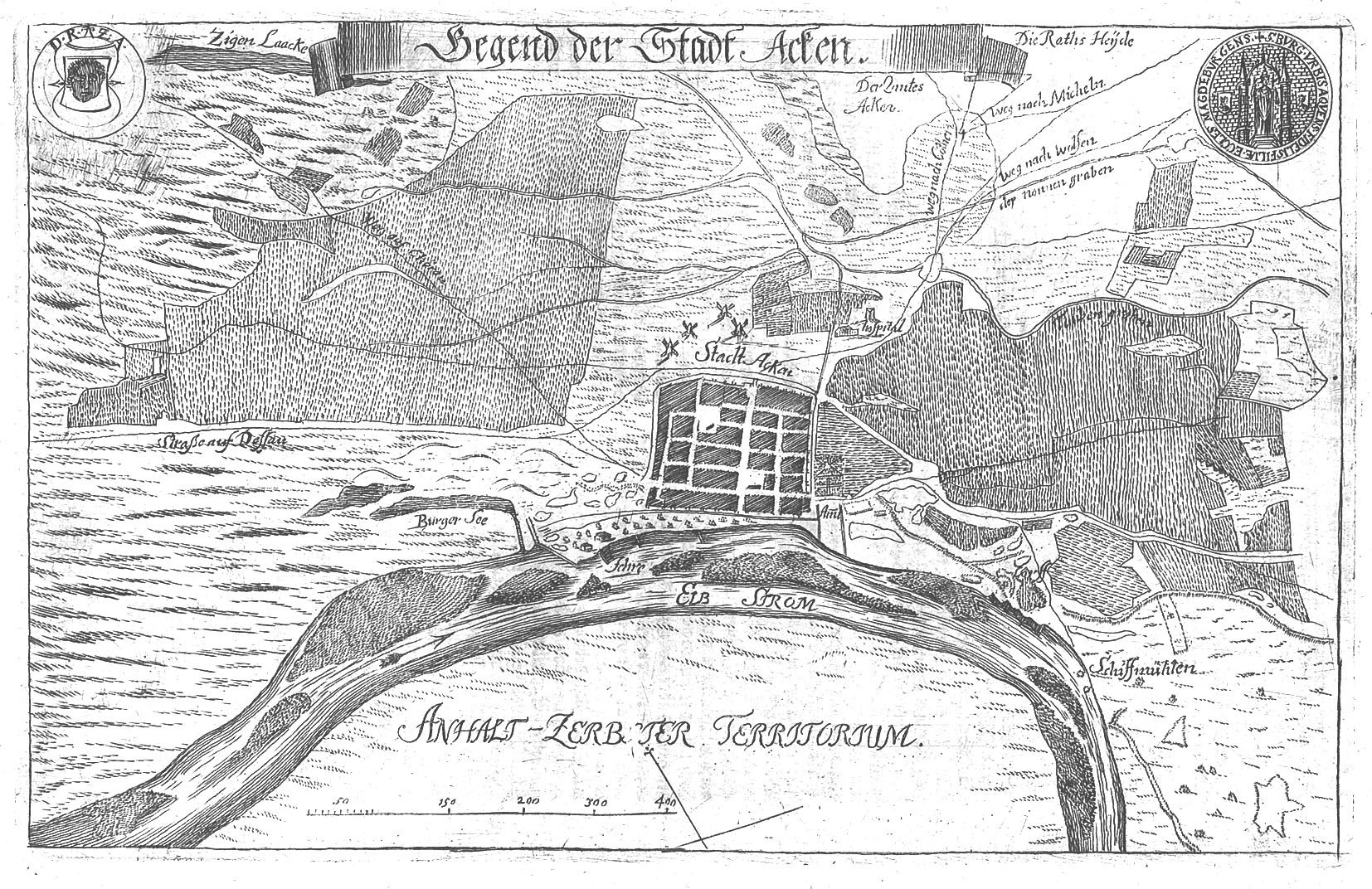
Fig. 1: Aken and its surroundings, 1720/21, source: Johann Heinrich Haevecker, Chronica und Beschreibung der Staedte Calbe, Aken und Wantzleben
It was not until the sons of Albrecht that a merchant’s house was recorded in documents in Aken in 1265, which also served as the town hall.[2] One year later, the marketplace is mentioned. In addition, there is evidence of a Schultheiß (town mayor) and of Schöffen (aldermen) for the first time in 1266. Information about their activities within the still young municipal community is provided by a Schöffenbuch (Book of Aldermen) of the town of Aken, fragments of which are still preserved today, the records of which go back to the year 1265 and are thus among the earliest among such sources from the area of distribution of Magdeburg law.[3] This work is one of the few surviving medieval sources on the town’s history, as the complete council archives fell victim to a town fire in 1485. The Book of Aldermen vividly illustrates the organization of the city’s government along the lines of Magdeburg law, in that it also attests to a college of aldermen in addition to the council. Various scribes worked on the Book of Aldermen, as can be discerned from the manuscripts documented there, which originate from different persons. The records mainly report on hereditary regulations, on the basis of which one can see, as is usual for Magdeburg law, that women could also inherit property, income and other rights. The Book of Aldermen also registers the names of important persons and officials of the city. For example, it mentions the names of the first aldermen, Bruno (1268), Heideke (1273) and Heinrich (1295), who were thus undoubtedly at the top of the municipal community. In 1271, the term town (civitas)[4] is mentioned for the first time in relation to Aken. The existence of aldermen is finally documented for the first time in 1288, although they may have already existed before. Thus, in the course of the 13th century, a typical civic community was established in Aken, which was oriented toward the customs of Magdeburg law.
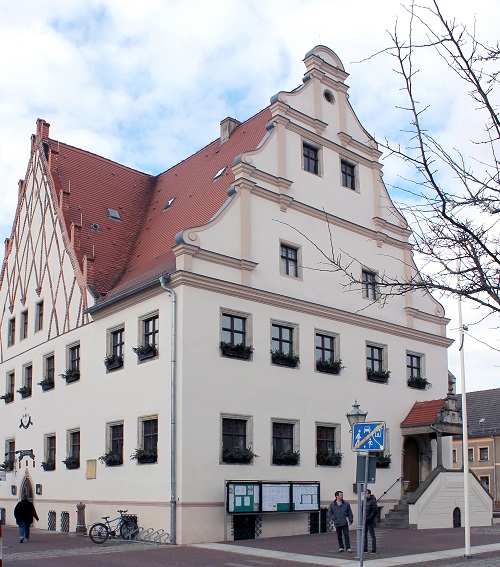
Fig. 2: Aken Town Hall, built following a town fire in 1485; it was also used as a market hall in the Middle Ages (photo: Sascha Bütow)
Between the 13th and 14th centuries, the Saxon dukes fostered the prosperity of the town of Aken. A proven means to this end was the Stapelzwang (compulsory staple), which required passing merchants to lay down their goods in Aken and offer them for sale to the local inhabitants. This regulation was valid for the land as well as for the waterway. It is unclear when Aken received this right. However, comparisons with other towns suggest that this could have happened as early as the 13th century. During this time, the Elbe played an important role as a Hanseatic arterial road. In particular, grain was transported on it in the direction of Hamburg. In addition, various goods, especially from Bohemia, such as sand, stones and wood were shipped, which were brought to Magdeburg via Aken.[5]
Not least because of this, a lively market life developed in Aken itself, in which various trades participated. Butchers owned sales stalls, the so-called Scharren, which stood directly by Marienkirche (St. Mary’s Church). In addition, there were shoemakers who owned a shoe hall first documented in 1268. Clothiers and tailors presumably presented their wares in the town hall, where there must have been specially equipped sales rooms. The cloth produced in Aken also enjoyed widespread use beyond the city limits. Thus, based on a statute from 1321, it is known that tailors from Zerbst processed further cloth made in Aken.[6] In order to be allowed to trade in Aken, customs had to be paid, which is documented here as early as 1230. This toll belonged to the dukes of Saxony and provided them with significant revenues. With the trade relations established in Aken, the town became part of the European traffic route network, as illustrated by the famous road map made in Nuremberg by Erhard Etzlaub (around 1460-1532) from 1501. Many long-distance traders must have known the place, as they could use it to bypass other customs points, such as Magdeburg or Wittenberg, thanks to the ferry that existed here.
Supervision of the market and control over the use of correct weights and measures was incumbent on the Aken town council, as was the organization of all inner-city life. The aim associated with this was primarily to ensure peace and the common good within the town. Based on this aspiration, Aken’s councilors formulated various legal principles that affected communal coexistence and were first summarized in the form of a Willkür (arbitrary code) around 1520.[7] As an impressive example of the council’s actions, this source contains not only a series of commands and prohibitions but also details of the punishments that were threatened if they were not observed. However, the archbishop of Magdeburg, as Aken’s city lord, reserved the right to confirm the regulations issued by the council.
The Aken citizenry was able to achieve considerable wealth in the late Middle Ages, which can be observed right down to individual persons. In 1392, for example, Claus Strynne, a native of Aken, acquired a share of the rights to a nearby wood district called Goldberg with fishing and meadow rights.[8] The citizens donated a not insignificant part of the fortune earned in this way to the churches of Aken in order to promote their own salvation. This primarily concerned St. Marienkirche (Church of St. Mary), to which e.g. church utensils, interest or entire plots of land were donated. The same applied to the Maria-Magdalena-Kirche (Church of St. Mary Magdalene), which was located on the territory of the older Slavic settlement and had to be demolished in 1542 due to flood damage.
Further south in the town, the citizens of Aken erected another parish church, which was first mentioned in 1265 and dedicated to St. Nicholas. Duke Johann I of Saxony (r. 1268-1285), however, converted this place of worship into a monastery in 1270, into which six canons moved.[9] Their task was to hold church services, commemorate the dead and lead an exemplary Christian life. The canons had ten houses in which they and their guests lived. The area was disrespectfully called “Pfaffenhof” (“parsons’ yard”) by the citizens of Aken, because the canons were often criticized because of their special rights. The Nicholas Monastery, for example, did not have to bear any of the city’s burdens, whereupon protests were voiced time and again. In 1288, the territorial sovereign mediated a compromise in which the canons agreed to contribute two pounds of groschen (pennies) for the appointment of the city guards and to pay ten silver marks for the construction of the Köthen Gate.[10] With this attitude directed against the monastery, the Aken councilors were conforming to a typical way of thinking within medieval city politics. According to this, in many places, the endeavor prevailed to have ecclesiastical communities participate in municipal expenditures and thus put the common good above any immunities and special ecclesiastical rights. However, this view should not be equated with a lack of piety among Aken’s citizenry. The opposite can be observed in late medieval Aken.
Traces of the medieval development have been preserved in the historic town center until today, although it was the 14th century that brought about tangible changes. During this period, the Aken council ordered new town defense constructions, which replaced wooden palisades with a stone wall first mentioned in 1335. Before that, gates and towers were built, of which the Burgtor (Castle Gate) Tower, the Dessau Tower and the already mentioned Köthen Tower have been preserved until today. These urban fortifications were strongly connected with the conflict between the Dukes of Saxony and the Archbishops of Magdeburg. Both parties claimed the possession of Aken and waged warlike conflicts around the town, in which the Gloworp castle was destroyed.[11] It was not until 1392 that a new, more castle-like structure was built by Archbishop Albrecht of Magdeburg (ruled 1383-1403). The coat of arms of Aken also changed with the Magdeburg city ruler. The head, which had already been used since the Middle Ages, was increasingly attributed to St. Mauritius, and likewise, a bishop’s figure was given a place in the center of the coat of arms, as it is still used today.
Author: Sascha Bütow
Citation:
Sascha Bütow, Aken. A planned market town of Magdeburg character, 18.06.2020, https://magdeburg-law.com/historic-city/aken/
Footnotes:
[1] On the Ascanian expansion in the area around Aken and beyond, cf. Partenheimer, Lutz, Albrecht der Bär. Gründer der Mark Brandenburg und des Fürstentums Anhalt. 2nd edition Cologne, Weimar, Vienna 2003, pp. 30 and 38.
[2] Neubauer, Ernst, Die Schöffenbücher der Stadt Aken. In Geschichtsblätter für Stadt und Land Magdeburg 30 (1895), pp. 251–328, here p. 253, no. 17.
[3] Magdeburg, Landesarchiv Sachsen-Anhalt (State Archive Saxony-Anhalt), cop., no. 405a.
[4] Schwieneköper, Berent, Aken, in, Handbuch der historischen Stätten, vol. 11: Provinz Sachsen-Anhalt, edited by Berent Schwineköper. 2nd edition Stuttgart 1987, pp. 2–4, here p. 3.
[5] Pelec, Ortwin, Die Elbe. Handelsweg vom 13. bis 17. Jahrhundert, in Alles im Fluss. Menschen, Waren, Häfen auf den Wasserwegen vom Rhein bis zur Weichsel, edited by Rudolf Holbach and Stephan Selzer, Wismar 2020, pp. 105-124, here p. 110.
[6] Referred to as “Akens want” (Aken Garment). See Codex Diplomaticus Anhaltinus. Vol. 3: 1301–1350, edited by Otto v. Heinemann, Dessau 1877, pp. 268-270, no. 409, here p. 269.
[7] Zahn, Wilhelm, Willkür der Stadt Aken, in Geschichtsblätter für Stadt und Land Magdeburg 18 (1883), pp. 196–199.
[8] Hertel, Gustav (ed.), Urkundenbuch der Stadt Magdeburg, vol. 1: until 1403. Halle (Saale) 1892, p. 438, no. 709.
[9] Zahn, Wilhelm, Die Stiftskirche St. Nicolai in Aken an der Elbe, in Geschichts-Blätter für Stadt und Land Magdeburg 19 (1884), pp. 47–79, 141–162, 266–293.
[10] Pfeffer, Friedrich Gottfried Carl, Chronik der Stadt Aken an der Elbe, Zerbst 1821, pp. 20-21.
[11] Georges, Otto, Geschichte der Stadt Aken an der Elbe, Köthen 1908, pp. 13-14.