Medieval City Development – Bridgehead, Seat of Power and Resolute Civic Community
In historical retrospect, the small town of Fürstenberg, located on the Oder River, is often overshadowed by the immediately neighboring Eisenhüttenstadt, which was systematically created in the mid-1950s as the first socialist planned city. Fürstenberg, which had been independent for centuries, was then incorporated as an urban district into the new and larger settlement. However, this modern development should not hide the fact that in the Middle Ages, Fürstenberg held an important position in the middle Oder region as a market town with customs and other municipal rights. The following explanations would like to take a look at the resulting role of Fürstenberg as a bridgehead and seat of power and also include the development of a resolute civic community according to Magdeburg law.
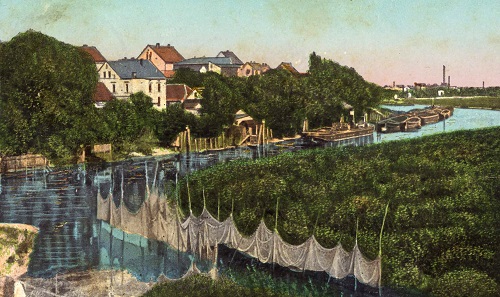
Fig. 1: Fürstenberg an der Oder. Since the Middle Ages, the town’s location on the river has been a cornerstone of its economy. The townspeople benefited from shipping, fishing, customs duties, and ferry services (detail from a postcard, 1903).
Fürstenberg, which was already small in the Middle Ages, is located about 30 kilometers south of Frankfurt (Oder). Thus, the settlement had a connection to an important traffic route because the Oder formed one of the most important trade routes for the traffic coming from Brandenburg, Lusatia and Silesia into the Hanseatic area. The resulting trade relations attracted especially the Pomeranian Szczecin. Numerous traffic tensions arose over this, which thus also made Fürstenberg an important stage point of the Oder traffic. However, the urban community, which had been gradually forming since the second half of the 13th century, could not prevail against the powerful Frankfurt, which held the dominant position in the middle Oder region. Nevertheless, it is very likely that already in Slavic times, there was a fortified complex or castle in Fürstenberg, which underlined the importance of the settlement.[1] From there, the monitoring of the traffic by land and by water took place.
Moreover, through sovereign privileges, a central traffic location was created in Fürstenberg in a typical manner. In early urban times, the margraves of Meissen from the Wettin dynasty were responsible for this process. A customs office originating from them is documented for the first time in 1286.[2] 40 years later, a customs officer working in Fürstenberg was documented to have illegally charged the merchants of Guben with customs payments. This resulted in a serious admonition from Brandenburg’s Margrave Johann and his mother, Duchess Anna of Breslau, as the merchants from Guben were able to invoke customs exemptions.[3] The fact that a ferry was located here also speaks for the great significance of Fürstenberg in the history of transportation. According to a document dating from 1335, this important infrastructural facility was “der stat rechte gut”[4] (“the justified right of the state”). which is a reference to the town law of Fürstenberg. This was based on the legal norms of Magdeburg, as a document from 1331 indicates. According to the text of the document, the citizens of Fürstenberg asked their town lord Abbot Johann von Neuzelle to confirm the validity of the Magdeburg law. As can be deduced, this had been valid in Fürstenberg since ancient times (ab antiquo). However, the citizens insisted on a deviation from the usual regulation in Magdeburg concerning the extent of the inheritance of a widow, which is only mentioned in general terms in the document. With regard to Heiner Lück’s research, this may well be considered typical, for it was, as in Fürstenberg, above all the law of inheritance that “was shaped in the city laws in a manner specific to the location.”[5]
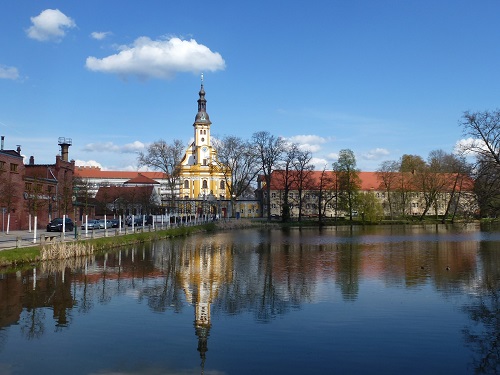
Fig. 2: Neuzelle Abbey. From 1316, the abbot and convent held the town of Fürstenberg. They were forced to sell it to Emperor Charles IV in 1370 and sought to reacquire it in 1406.
All in all, the regulations of the Fürstenberg town charter provided the basis for the town to be a compulsory point of traffic, which applied mainly to those who did not have the corresponding customs exemptions. The town thus had an effect on the surrounding countryside via its rights, and in doing so it focused in particular on river traffic. There is no doubt that Fürstenberg was very attractive. It offered its owner the possibility of access to the Oder and a by no means insignificant marketplace, where a considerable amount of customs revenue flowed together. Not least from this perspective, the acquisition of the small town by the Neuzelle monastery in 1316 can be comprehended. The connection to the traffic on the Oder and a market for the surpluses generated within the own manor were, therefore, also for the monastery of Neuzelle important intentions connected with the acquisition of Fürstenberg. The monks also ensured free passage from one bank of the Oder River to the other for themselves and their tenants in Fürstenberg.[6] During the course of the 14th century, the Fürstenberg citizenry, for its part, advocated an expansion of municipal rights and privileges. In 1350, for example, they obtained further exemptions from customs duties in the Margravian region from Margrave Ludwig of Brandenburg.
Thus, from an infrastructural point of view, Fürstenberg was anything but a “tabula rasa” when Karl IV very probably urged the Neuzelle monastery to sell him the “stetyl” (“small town”), as it was called, in 1370. This acquisition of Fürstenberg is documented on the one hand by a deed, but also by the chronicle of Benesch von Weitmühl. In the latter, it says about the year 1370 that Karl bought a small town on the Oder in the Lusatia region, which was called Fürstenberg and was located near Frankfurt. There, he built a castle very close to the river and also fortified the town. In addition, Karl had a bridge built over the Oder. During all these construction measures, the emperor himself was in Fürstenberg to inspect their progress.[7]
If one assesses these statements of the Bohemian chronicler, it must first be noted that Karl by no means had a castle built from scratch. As already mentioned, there was already a fortified manorial site there. On the contrary, Karl seemed to have made extensions and changes. The aforementioned bridge construction did not seem to have been massive either since this structure is not being referred to after Karl. At least, however, it seemed to have actually existed. This is indicated by a document of the ruling margrave Otto von Wittelsbach from 1371. In this document, the Brandenburg sovereign complained that Karl IV had broken his word and his covenant and, to make matters worse, had built a bridge, by which he meant the one in Fürstenberg. The margrave made it unmistakably clear that this was “wider vnszern vnd vnszer Lande willen” (“against our will and our country’s will”).[8] This clearly indicates that in 1370/71, the Brandenburg side was observing the events in Fürstenberg very closely. For Karl, this all but inconspicuous place offered an important bridgehead through which he could reach the Mark from Bohemia and Silesia. At the same time, he snubbed the powerful city of Frankfurt, which in its history had several times acted against competing Oder crossings to protect its own staple and city rights. Karl apparently consciously exploited this situation in terms of power politics by exerting pressure on Brandenburg with the increasingly expanding Fürstenberg, the acquisition of which was becoming ever more obvious to him and which he actually succeeded in acquiring a little later. Thus, Fürstenberg became anything but quiet. The place remained significant for Karl. Still, in 1371, after the acquisition of the town, he had confirmed the rights of the citizenship in a typical way. In 1374, for his part, he endowed the Fürstenbergers with trading and traffic rights by waiving customs and escort duties “in navigio vel curribus” (“by ship and wagon”) for their goods to be transported through the Mark Brandenburg.[9] The sovereign interests in Fürstenberg were represented by a captain appointed by Karl, who is still mentioned in 1390 in the context of a dispute about the borders running between the town and the village of Vogelsang.[10]
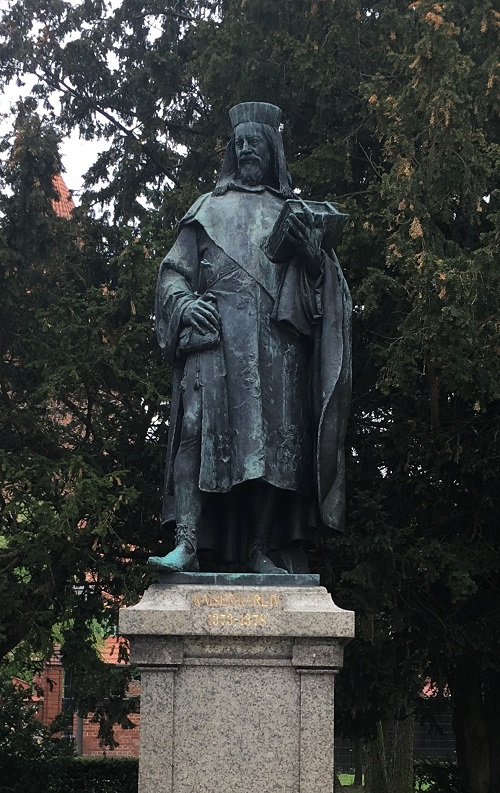
Fig. 3: Monument to Emperor Charles IV in Tangermünde. The renowned Luxembourg ruler developed Fürstenberg as part of his efforts to acquire the Margraviate of Brandenburg. Following his purchase of the margraviate in 1373, he shifted the focus of his rule to Tangermünde for a time.
If, on the other hand, one takes a final look at what Karl left behind in Fürstenberg after his death, it is striking that the Neuzelle monastery obviously made a sustained effort to reacquire the town. Under the rule of Margrave Jobst of Moravia, this succeeded in 1406[11], again opening the door for new local planning. As already mentioned, nothing else is known about the bridge erected by Karl in the 15th century. From the Neuzell inheritance register, which was compiled in the first half of the 15th century and has been handed down in fragments, it can be discovered that the monks had secured the Oder crossing located at Fürstenberg “ane mite” (“at the middle”) and “ummesuͤst” (“for free”) on the basis of old conventions, which suggests a continued operation of the ferry, which was under municipal law.[12] The customs in Fürstenberg, on the other hand, became an object of manorial commercialization at the turn of the 14th and 15th centuries. Thus, half of the fees to be paid went into the hereditary possession of Nickel Krebs, a citizen of Guben, with the right to resell the customs.[13] The father of Nickel Krebs had already possessed a similar right. This illustrates the great influence of the city of Guben on the Oder trade leading to Pomerania.
Thus, Fürstenberg remained an important stage for this trade even after Karl. As can be seen from a confession of the Sprottau council from 1483, the local merchants also played an active role in this trade.[14] The merchants had confirmed that they embarked their goods in Crossen on the Oder according to old traditions and transported them either overland or further by water to Pomerania. In this connection, they had always paid the usual customs duty not only in Frankfurt but also in Fürstenberg. The legal city, which was organized according to the Magdeburg model, thus inserted itself beyond the Middle Ages as an important marketplace into the network of urban communities of the middle Oder region.
Author: Sascha Bütow
Citation:
Sascha Bütow: Fürstenberg (Oder). Medieval City Development – Bridgehead, Seat of Power and Resolute Civic Community, 27.07.2020, https://magdeburg-law.com/historic-city/furstenberg-oder/
Footnotes:
[1] Lehmann, Rudolf, Fürstenberg a. d. Oder, in Handbuch der historischen Stätten, vol. 10: Berlin und Brandenburg, edited by Gerd Heinrich. 3rd edition Stuttgart 1995, pp. 192–193, here p. 192.
[2] Theuner, Emil (ed.), Urkundenbuch des Klosters Neuzelle und seiner Besitzer, Lübben 1897, no. 7, p. 7.
[3] Ibid., no. 20, p. 15.
[4] Ibid., no. 41, p. 27.
[5] Lück, Heiner, Stadtrechte in der Altmark – ein Überblick, in Sachsen und Anhalt 32 (2020), pp. 41–77, here p. 63.
[6] UB Neuzelle (same as note 2), no. 41, p. 29.
[7] Bütow, Sascha, Die Hanse im Blick. Verkehrsplanung und Wegelenkung Karls IV. im Umfeld der Erwerbung der Mark Brandenburg im Jahr 1373, in Karl IV. Ein Kaiser in Brandenburg, edited by Jan Richter, Peter Knüvener and Kurt Winkler, Potsdam 2016, pp. 61–65.
[8] Riedel, Adolf Friedrich, Codex Diplomaticus Brandenburgensis, series B, vol. 2, no. MCXV, pp. 509–511, here p. 509.
[9] UB Neuzelle (same as note 2), no. 69, p. 49.
[10] Ibid., no. 77, pp. 53-54.
[11] Ibid., no. 86, pp. 59-60.
[12] Ibid., annex no. 1, p. 117.
[13] Ibid., no. 137, p. 89.
[14] Ibid., no. 113a, pp. 115-116.
Images:
Fig. 1: zeno.org
Fig. 2: photo: Peter Kuley, 2012
Fig. 3: Zentrum für Mittelalterausstellungen, photo: Martin Müller