Under Monastic Authority from Village to Small Town
In the Middle Ages, the present-day district town of Luckenwalde was not one of the important towns in the Fläming region but was overshadowed by larger municipalities such as neighboring Jüterbog. Nevertheless, its location in the border region between the archbishopric of Magdeburg, the Mark Brandenburg and Lower Lusatia enabled a growing market traffic in the late Middle Ages. Luckenwalde was a stage point on the route between Berlin and Leipzig, which led via Wittenberg, Zahna, Jüterbog, Luckenwalde and Trebbin.[1] This route, however, was in competition with a second road running via Rietz, Treuenbrietzen, Beelitz and Saarmund so that Luckenwalde benefited only to a limited extent from the medieval traffic flows (fig. 1).
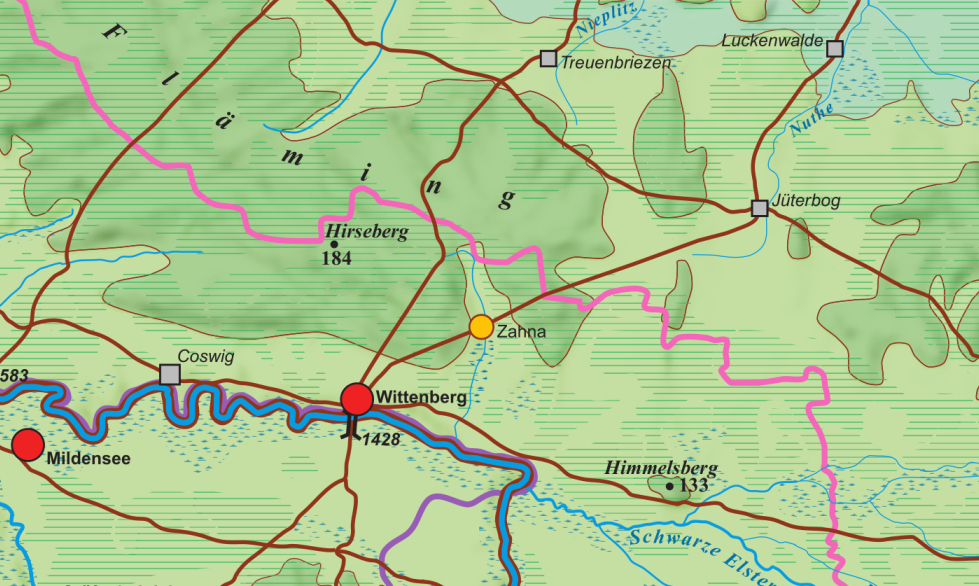
Fig. 1: Luckenwalde’s location within the transport network of the Fläming region. Treuenbrietzen and Jüterbog, among others, were strong competitors for economic development.
Nonetheless, a certain prosperity developed within the town, which had belonged to the Zinna monastery since 1285,[2] in the 15th century, based on market activity and trade. In this context, the inhabitants of Luckenwalde received a significant privilege from Archbishop Günther of Magdeburg in 1430, according to which they were allowed to brew beer and engage in trade and crafts. Luckenwalde thus enjoyed important municipal rights, but this brought it into conflict with the Jüterbog council, which intended to prevent brewing in the area of the Zinna monastery in favor of its own municipal market. The lawsuit brought by Jüterbog before the archbishop of Magdeburg led to the result that the abbot of Zinna was still allowed to brew, but the villages under his rule were not. An explicit exception was the “dorff” (“village”) Luckenwalde, with the reference that its inhabitants were allowed to brew and sell “wenne sie wollen” (“if they want”). In addition, the village was allowed to have “handtwerglüte In allermasse als [es] In Steten” (“craftsmen, as was the case”) in towns in the surrounding area.[3] This comparison with the surrounding towns demonstrates very clearly that Luckenwalde was in the process of leaving behind its settlement status as a village. As research emphasizes, this development seemed to be important to the monastery of Zinna.[4] Finally, in 1471, mayor, council and aldermen are mentioned, and in 1480, even a town hall.[5] This clearly indicates that in the late medieval Luckenwalde there was a council-like constitution typical for towns.
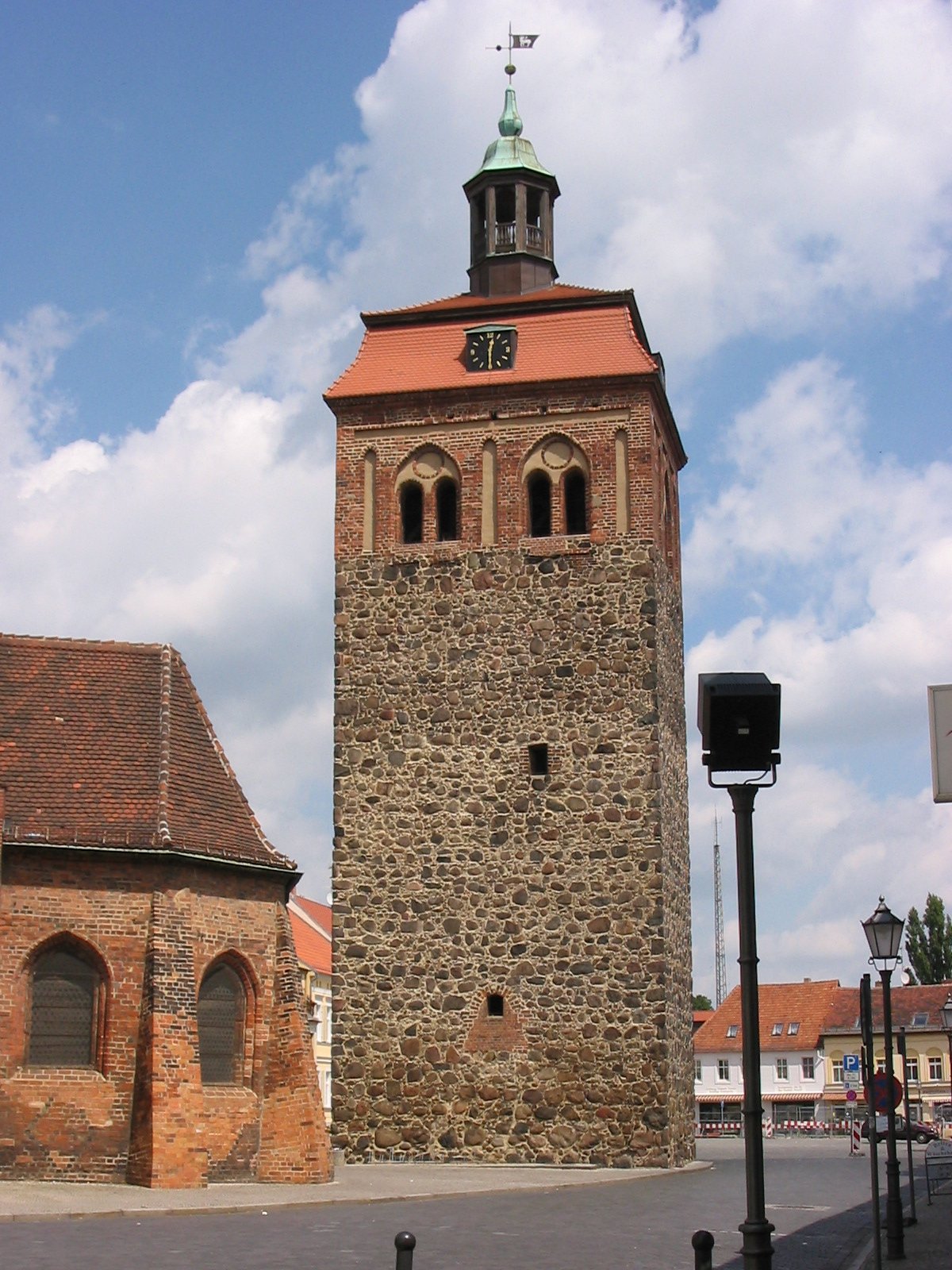
Fig. 2: The Market Tower in Luckenwalde remains a landmark of the town to this day. Since the Late Middle Ages, the adjacent parish church of St. John has used it as its bell tower; its oldest parts date back to the 12th century.
Not least, due to Archbishop Günther’s comparison with the privileges of neighboring towns, the assumption is obvious that the inhabitants of Luckenwalde oriented themselves to the regulations of Magdeburg law. This also suggests an undated legal dispute of the widow Hedwig Palm about money payments of Hans Schwueck, who lived in Luckenwalde, against the background of which the aldermen of the town of Luckau, who were oriented towards Magdeburg law, were involved in seeking help.[6] Although a town law privilege has not been handed down, Luckenwalde appears in the transition to the 16th century as an oppidum, i.e. small town, endowed with important municipal rights, as the fragmentary chronicle of the Zinna monastery attests.[7] Linen weavers seem to have been particularly important for the settlement, as is attested by the formation of a corresponding guild, which is documented for the year 1493.[8] It is, at the same time, evidence of the Wendish inhabitants, who lived in Luckenwalde in large numbers and possessed their own rights as elsewhere.
The municipal development of Luckenwalde can also be seen a little later in a will written in 1540 by the Zinna abbot Matheus, with which “alle Erbarckeit, zucht und guter wandel” (“all honesty, discipline and good moral conduct” were to be maintained.[9] In this source, Luckenwalde is referred to as a “Flecken”, which means a small-town settlement with market traffic and trade. The abbot’s will was written against the background of the spreading Reformation and out of authoritative power in consensus with Archbishop Albrecht of Magdeburg. Accordingly, it mainly contains regulations concerning worship and the retention of the Catholic faith.
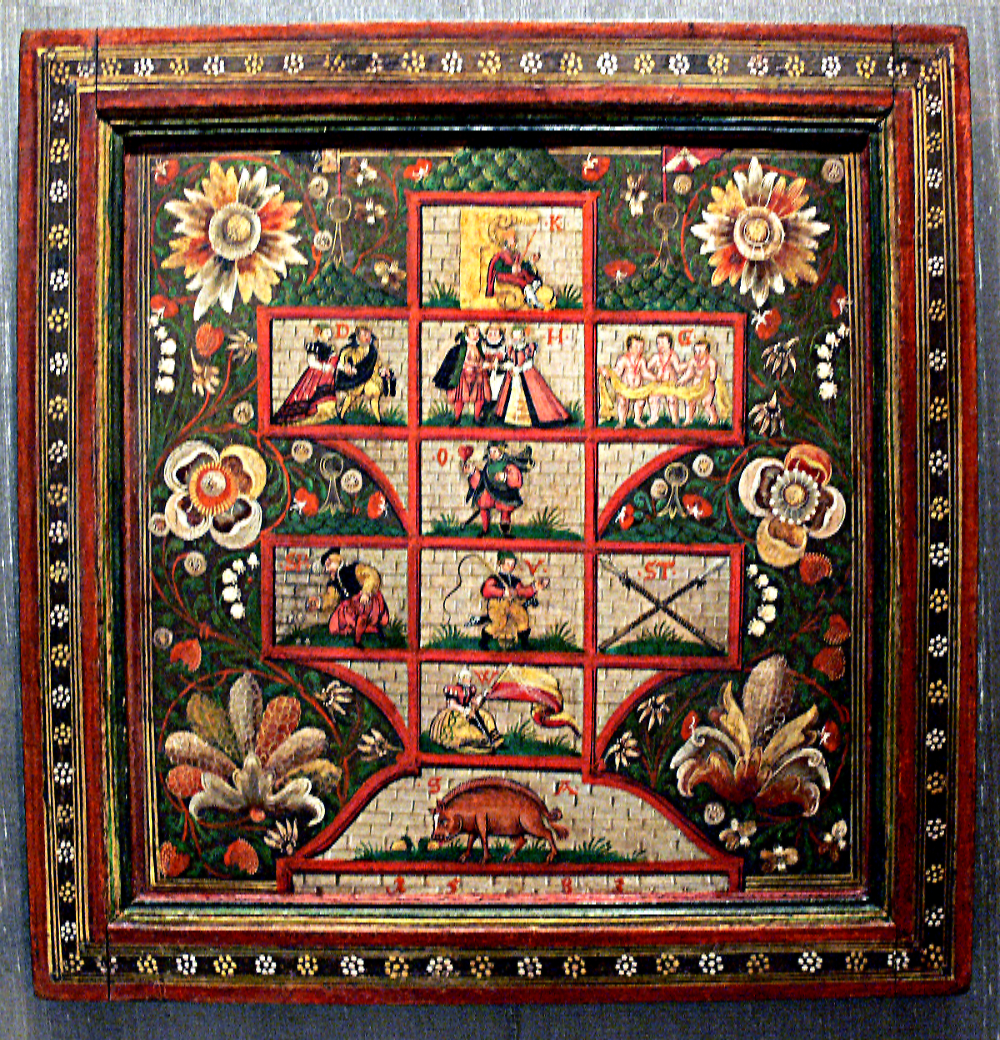
Fig. 3: Game board for the “Game of Fortune,” dating from 1583, from the Bavarian National Museum in Munich.
In this context, the Luckenwalde community must also be examined more closely. Thus, among other things, the will reports about bakers and grocers, i.e. small traders, who were to refrain from offering their goods for sale during church services and masses under penalty. Furthermore, brewers and innkeepers are mentioned, who were supposed to stop the pot game (topffelspiel) in their inns and taverns. For this game, also known as “Glückshaus”, popular in the late Middle Ages, people used cards or dice and played for money, which is why it was stigmatized, especially by clergymen (fig. 3). With regard to the constitution of Luckenwalde, the regulation that the landlords had to report gambling to the council, whereupon the gamblers were to be seriously punished by the council lords, deserves attention. The latter had the power to penalize within Luckenwalde and collected the fines in the form of money payments. A bailiff appointed by the monastery was allowed to intervene in the punishment of violent criminals and agitators. The council, for its part, was assisted in the supervision of the municipal regulations by “Stadt Knechte” (“town bailiffs”) whose task was, among other things, to teach strangers the customs and regulations in Luckenwalde.
After the dissolution of Zinna Monastery in 1553, Luckenwalde remained under the jurisdiction of the Archbishopric of Magdeburg and was administered by a governor. He took over the high jurisdiction from the monastery, while the Luckenwalde council retained the lower jurisdiction, which had already been confirmed by Archbishop Günther in 1430.[10] The population of Luckenwalde increased in the 16th century, as can be seen from the expansion of the Jüterboger Vorstadt in the mid-16th century in a southwesterly direction and later from the emergence of the Trebbin suburbia in the north.[11] Despite the manorial transformations, older economic branches of the monastery, such as wine-growing, were preserved. It was continued by a wine lords’ guild founded in 1556 under municipal sponsorship.[12] Beer brewing also remained an important part of Luckenwalde’s economy, as evidenced by the mention of the brewers’ guild in 1608. This clearly demonstrates the continuity of the urban development of Luckenwalde, which finally fell to Brandenburg in 1680, from the Middle Ages to the early modern period.
Author: Sascha Bütow
Citation:
Sascha Bütow: Luckenwalde. Under Monastic Authority from Village to Small Town, 29.06.2021, https://magdeburg-law.com/historic-city/luckenwalde/
Footnotes:
[1] Sascha Bütow, Verkehrsraum Fläming in überlandschaftlichen Konturen. Spätmittelalterliche Wegelenkung, Straßenbaumaßnahmen und historische Kartographie, in Blätter für deutsche Landesgeschichte 151 (2015), pp. 275–290, here p. 277.
[2] Fritz Geisthardt, Luckenwalde, in Handbuch der historischen Stätten Deutschlands, Vol. 10: Berlin und Brandenburg, edited by Gerd Heinrich, Stuttgart 19953, pp. 271–273, here p. 271.
[3] Magdeburg, Landesarchiv Sachsen-Anhalt Abt. Magdeburg, Rep. A 2, no. 988, fol. 7v.
[4] Oliver H. Schmidt and Dirk Schumann, Zinna. Zisterzienser, in Brandenburgisches Klosterbuch. Handbuch der Klöster, Stifte und Kommenden bis zur Mitte des 16. Jahrhunderts, vol. 2, edited by Heinz-Dieter Heimann, Klaus Neitmann and Winfried Schich, Berlin 2007, pp. 1359–1384, here p. 1367.
[5] Same as note 2, p. 272.
[6] Rudolf Lehmann (reviser), Quellen zur Geschichte der Niederlausitz, part 2, Cologne/Viena 1976, annex no. 3, p. 110.
[7] Cf. on this the entry in the fragmentary handed down chronicle of the monastery Zinna by Adolf Friedrich Riedel (ed.), Codex Diplomaticus Brandenburgensis, series D, vol. 1, Berlin 1862, no. 12, pp. 296-297.
[8] Willi Hoppe, Eine mittelalterliche Leinewebergilde in Luckenwalde, in Forschungen zur brandenburgisch-preußischen Geschichte 24 (1911), pp. 529–546.
[9] Adolf Friedrich Riedel (ed.), Codex Diplomaticus Brandenburgensis, series A, vol. 11, Berlin 1857, no. 259, p. 472.
[10] Peter P. Rohrlach (reviser), Historisches Ortslexikon für Brandenburg. Part X: Jüterbog-Luckenwalde, Weimar 1997, p. 312.
[11] Same as note 2, p. 272.
[12] Roland Fröhlich, Die Zisterzienser und ihre Weinberge in Brandenburg, Berlin 2010, p. 191.
Images:
Fig. 1: Magdeburg, Zentrum für Mittelalterausstellungen, Section of the map “Long-distance trade routes in central Germany from the 13th to the 16th century”.cartography: G. Pápay
Fig. 2 and 3: Wikimedia Commons, photo: Jörgen Kosche
Fig. 4: Wikimedia Commons, photo: Knorrepoes