Small Hanseatic Town – Self-confident Civic Community
Much about the medieval town history of Kyritz remains in the dark. Almost the entire stock of deeds, files, town books and other documents was destroyed by various fires in the 17th and 18th centuries. This particularly affects statements about the constitutional evolution of the town. Little is known about the local legal customs within the town community. Nevertheless, the known developments of the municipal rights in Kyritz and the extension of its privileges can be outlined. From this, the picture of a self-confident civic community striving to expand its privileges can be gained.
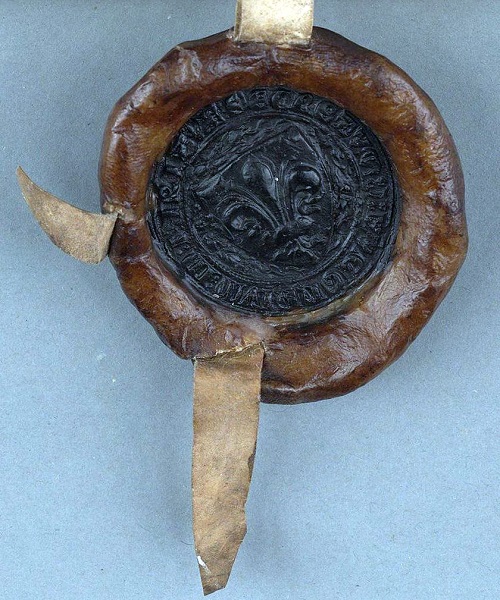
Fig. 1: Seal of the Kyritz City Council (1476).
In the course of the 13th century, Kyritz evolved into a town of law. This process did not take place without the help of the von Plotho family, which held the town lordship during this time. This family was one of the ministerials of the archbishop of Magdeburg and possessed, among other things, landed property near Altenplathow between Jerichow and Genthin.[1] Land expansion and Christianization enabled the lords of Plotho to develop an independent dominion in the Prignitz in the area around Kyritz, which already had important center functions in Slavic times.[2] The town itself was rebuilt around 1200 with the support of the lords of Plotho, starting from the church of St. Nicholas. At the express wish of the settlers, they were granted the Stendal law in 1237, which was closely related to the Magdeburg law.[3] The town thus had a council-like constitution, which allowed the citizens to regulate their own affairs legally. This right found a material expression in the use of a seal, with which legal transactions were confirmed. A particularly beautiful version of the Kyritz council seal has been preserved in a document from 1467, which has been archived in the Tallinn city archives. It contains the characteristic lily of the von Plotho family in the center of the seal image.
The sovereign research estimates that gradually about 1,000 to 3,000 people settled in Kyritz.[4] Within this population, a flourishing economy developed during the first half of the 13th century. A vivid example of this is a privilege of the lords of Plotho dating back to 1245, with which they confirmed the rights of the local garment tailors. It is interesting that they referred to an older statute of the local guild of garment tailors from Stendal (“[…] fratres Gilde et incisores panui in stendal […]”).[5] Accordingly, the wording of both documents is identical, with the exception of the adapted names of persons and places. Thus, the legal customs within the city of Stendal proved to be exemplary for Kyritz and were transferred here in the course of a longer-lasting transfer of rights. The “honorable men” (“honesti viri”) named at the end of the document and residing in Kyritz, who are mentioned as witnesses of the legal negotiation, may have played a decisive role in the establishment of the garment tailor privilege in its present form. This evidence also deserves attention since it can be assumed that transfers under town law were often negotiated between the town lord and the civic community.[6]
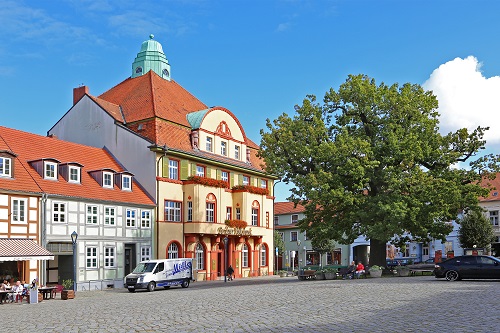
Fig. 2: Market square in Kyritz. The town was laid out according to a planned urban scheme in the first half of the 13th century, and traces of its medieval urban layout have survived.
An additional source that provides information about the rights of the town of Kyritz dates back to the year 1259 and has also been handed down in the form of a document of the lords of Plotho. It primarily concerns the municipal trade because the citizens of Kyritz were confirmed with the document to navigate the Jägelitz River flowing through the town and its tributaries up to the Havel River without any restrictions. This regulation referred to the trade intended by the Kyritz council, which was directed to the Hanseatic area and took place by water during the shipping time. An important stage destination mentioned in the document was Havelberg, where a margravial customs duty had to be paid. The citizens of Kyritz had to pay a coin for every ship’s load that passed through here. Conversely, the citizens of Kyritz received the assurance that the shipping they carried out was not to be interfered with by anything. The permission to navigate the Jägelitz was an essential right for the still young Kyritz since a large part of the goods transport must have taken place over this river further in the direction of Havel and Elbe. Grain, wood and cloth were among the goods Kyritz merchants and carters transported primarily to Hamburg.
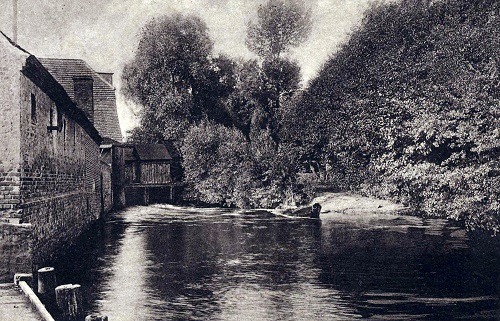
Fig. 3: The Jägelitz River flowing through Kyritz. In the Middle Ages, the town council secured important rights, including those relating to navigation, milling, and fishing (view from around 1900).
These citizens, who were active in long-distance trade, as well as the other inhabitants of Kyritz, experienced a change in the rule of the town in the period between 1259 and 1307. During this period, the Margrave of Brandenburg must have succeeded in gaining possession of the town of Kyritz, although more precise details remain unknown due to the already mentioned unfavorable source situation. From 1325 on, however, Kyritz can be regarded as a sovereign town. The leading figures in the town’s politics were wealthy merchants, who, as in many other Brandenburg communities of that time, traded in cloth. [7] They accessed the goods of the cloth manufacturers, who, for their part, were largely excluded from the cloth trade. Often they rebelled against the town government for this reason, examples of which can also be found in Kyritz. In 1383, the cloth and garment makers succeeded in enforcing a limited sales permit against the prerogatives of the cloth cutters.[8] In this way, they no longer had to sell white and gray cloth to middlemen but were allowed to offer it themselves at markets. Kyritz is thus a typical example of intra-urban conflicts over civic rights and political participation, which were mostly carried into the population by guilds, quartermasters and neighborhood masters. In the middle of the 14th century, such forces succeeded in gaining a say in the appointment of the Kyritz council.[9]
The interests of the Kyritz council were not only related to trade far beyond the city limits. The same was true in political and sovereignty terms. Thus, in 1325, the city of Kyritz participated in the formation of an alliance between towns of the Prignitz and various representatives of the Moravian knighthood living in its vicinity. Since the Ascanian dynasty, which ruled Brandenburg, had become extinct a few years before, this circle saw the necessity to guarantee legal security and the maintenance of old privileges in joint responsibility. In the case of legal disputes or the questioning of privileges, it was determined that related arbitrations should be handled as was customary in the times of the margrave (“bi der marcgreuen tiden”) [10]. These and other regulations were negotiated beforehand at a meeting in Kyritz between the parties involved so that the town became the place of issue of the mentioned document. The guarantee of land peace also played an important role here, which was not only discussed in 1325 but also provided the occasion for another meeting in Kyritz in 1363. Duke Albrecht of Mecklenburg took part in this meeting, as did Prince Lorenz von Werle. Undoubtedly, this shows that Kyritz, as a prosperous town, was able to make all the necessary arrangements for the holding of such a day, including quartering, catering and entertainment. Last but not least, this reflects the reputation of the small Hanseatic town and its self-confident civic community in the late Middle Ages, although the historian would like to get hold of far more such informative and insightful sources.
Autor: Sascha Bütow
Citation:
Sascha Bütow: Kyritz. Small Hanseatic Town – Self-confident Civic Community, 31.07.2020, https://magdeburg-law.com/historic-city/kyritz/
Footnotes:
[1] Römer, Christof, Genthin, in Handbuch der historischen Stätten, vol. 11: Provinz Sachsen Anhalt, edited by Berent Schwineköper. 2nd edition Stuttgart 1987, pp. 133–135, here p. 133.
[2] Kirsch, Kerstin, Slawen und Deutsche in der Uckermark. Vergleichende Untersuchungen zur Siedlungsentwicklung vom 11. bis zum 14. Jahrhundert. Stuttgart 2004, p. 76.
[3] Lück, Heiner, Stadtrechte in der Altmark – ein Überblick, in Sachsen und Anhalt 32 (2020), pp. 41–77, here p. 54.
[4] Beck, Lorenz Friedrich, Die Prignitzstädte Perleberg, Pritzwalk, Kyritz und Havelberg und die Hanse, in Jahrbuch für die Geschichte Mittel- und Ostdeutschlands 52 (2006), pp. 89–152, here p. 126.
[5] Riedel, Adolf Friedrich (ed.), Codex Diplomaticus Brandenburgensis, series A, vol. 1, no. II, pp. 366–367, here p. 366.
[6] Lück, Heiner, Sächsisch-magdeburgisches Recht zwischen Elbe und Dnjepr, in Kulturelle Vernetzung in Europa. Das Magdeburger Recht und seine Städte, edited by Gabriele Köster, Christina Link and Heiner Lück. Dresden 2018, pp. 13–27, here pp. 25–26.
[7] Helbig, Herbert, Gesellschaft und Wirtschaft der Mark Brandenburg im Mittelalter. Berlin/New York 1973, pp. 18–22.
[8] Gressel, Hans, Die Stadt Kyritz: Entwicklung, Verfassung und Wirtschaft bis zur Städteordnung 1808/09. Berlin 1939, p. 93.
[9] Beck, Lorenz Friedrich, Die Prignitzstädte (same as note 4), p. 150.
[10] Riedel (same as note 5), no. XXVI, pp. 136–137, here p. 137.
Images:
Fig. 1: Tallin, Tallinna Linnaarhiiv Tallinna Magistraat TLA.230.1-II.107 (Tallinna Linnaarhiiv Tallinna Magistraat TLA.230.1-II.107, in: monasterium.net, URL </mom/EE-TLA/TallinnaMagistraat/TLA.230.1-II.107/charter>, accessed at 2020-07-27Z)
Fig. 2: photo: W. Bulach, 2015
Fig. 3: zeno.org