Site of the State Parliaments of the Lower Lusatian Estates
The district town of Lübben (Spree Forest) is located in Lower Lusatia and is part of the official settlement area of the Sorbs or Wends. It can look back on an important history, which one can hardly guess in today’s cityscape.
In the course of the 15th century, the town established itself as the capital of Lower Lusatia and remained so until 1815, when the majority of the state parliaments were held in Lübben.
Conveniently located regarding transport facilities between the Upper and Lower Spree Forests, the area was first settled about 12,000 years ago. Protogermanic peoples of the “Lusatian culture” can be traced back archaeologically as well as later Germanic and Slavic tribes.
In the Nienburger Bruchstück (Nienburg Fragment), the inventory of the Nienburg monastery created around 1150/1180, the castle town of Lübben is mentioned for the first time with the urbs lubin.[1]
The granting of Magdeburg town law is believed to have taken place between 1210 and 1220; no document has survived.[2] Soon after, the Sachsenspiegel, a law book of Saxony, was written down by Eike von Repgow. In Lower Lusatia, both laws were applied side by side; they complemented each other. The Sachsenspiegel regulated, among other things, questions of coexistence between Germans and Slavs. In Lower Lusatia, the latter represented the majority of the population for several centuries. The legal principles were certainly implemented even before they were written down. In the Sachsenspiegel, there was no specification of a town law; instead, land law and feudal law were dealt with. Therefore, the granting of the Magdeburg town law closed a gap.
Around 1300, Lübben changed hands. The Nienburg monastery gave it to the Dobrilugk monastery (today Doberlug-Kirchhain). This, in turn, passed the town and the castle (castrum et opidum Lubbyn) on to the Saxon Duke Rudolf I as early as 1329. Due to the often peripheral location of Lower Lusatia, many other changes of dominion followed in the subsequent decades and centuries, often through pledges.
After protracted disputes between the Brandenburg Margrave and Elector Otto V and Emperor Charles IV, which were settled by the Treaty of Fürstenwalde on August 18, 1373, the town fell to the Emperor, who assigned it to the Kingdom of Bohemia. However, Saxon princes remained the town rulers until 1422.
The transfer of Lower Lusatia to the Bohemian crown established a division of the courts into two parts. The bailiff was responsible for the high court, and a tribunal of the estates decided civil disputes.
In 1402, a judge for Lübben is mentioned for the first time. His competencies are not specified. In the first decades, he ruled on disputes concerning family law issues such as payment obligations and inheritance matters. In the case of manslaughter (1429), the mayor and council of Lübben decided on the payment of a wergeld (atonement fee) without corporal punishment.
From 1461 onwards, there are records of court sessions consisting of a town judge and a sitting council. Sessions were held at Easter and Christmas.
Later, Lübben was ruled by bailiffs who had received the lordship over the town from the Bohemian king.
In the 15th century, Lübben developed into a sovereign town. On October 18, 1448, the town of Lübben was seized by the Brandenburg margrave Friedrich II Eisenzahn. The bailiffs were only poorly compensated with 10,000 Rhenish florins. [Fig. 1]
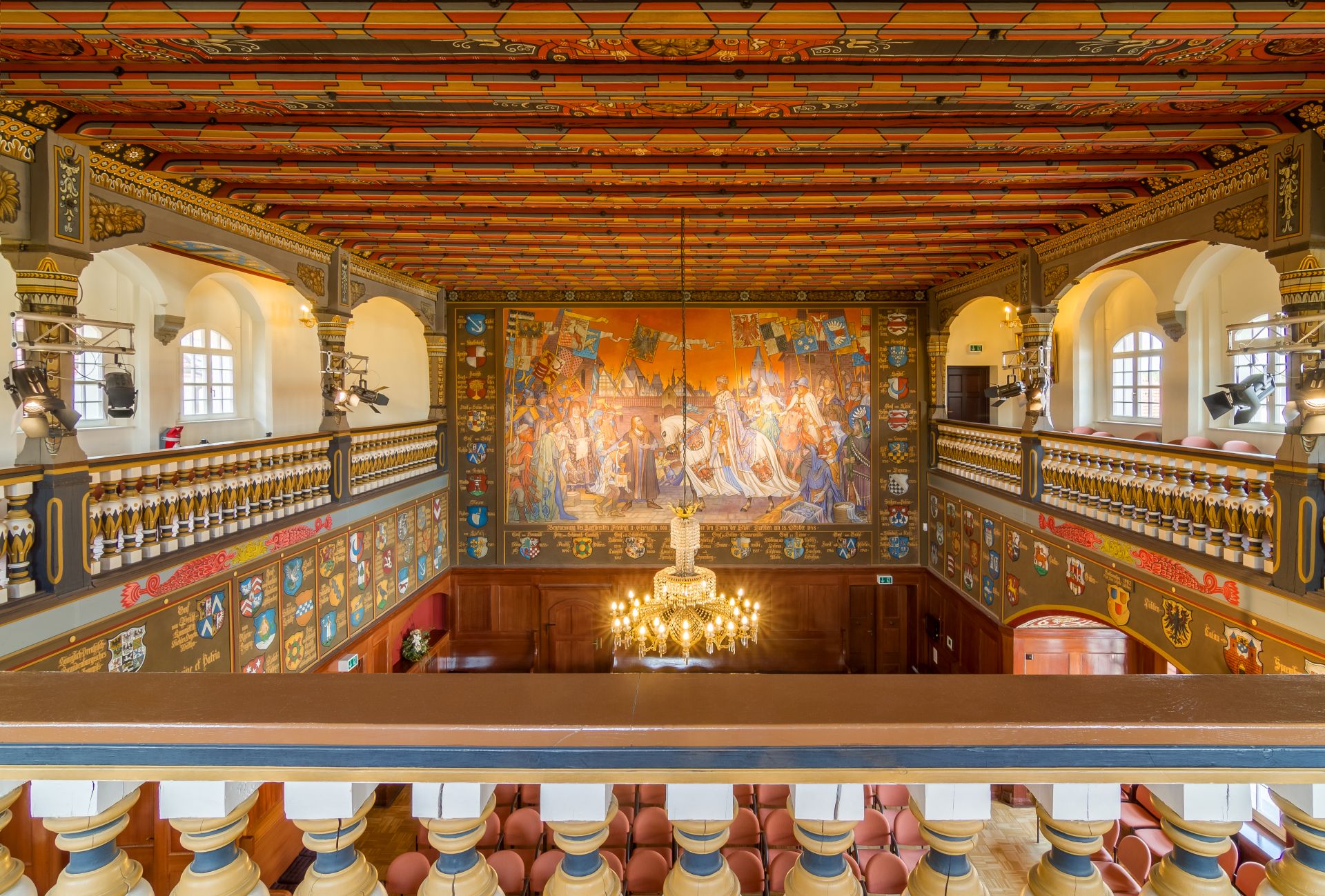
Fig. 1: The occupation of the town, romanticized in a painting in the Lübben Heraldic Hall by August Oettken.
Only 14 years later, from 1462, Lübben was again Bohemian and thus fell to the Habsburgs in 1526. In 1463, the Bohemian king put the Germans and Sorbs on an equal legal footing.
In 1538, the court of the estates was given its own district court order; it was arranged between the municipal court of aldermen and the district bailiff. In 1549, the city of Lübben acquired the “Free Court”. In this way, the town judge, who was selected by the sovereign, was replaced by the supreme mayor and confirmed by annual election.[3]
In 1598, Emperor Rudolf II. confirmed Lübben’s indigenate (the right by the place of birth) and the right of presentation, and only men born in Lower Lusatia who had been proposed to the Emperor for the office by the estates were allowed to become bailiffs.
In 1665/1666, the jurisdiction was again changed. Christian I of Saxony-Merseburg, the constructor of Lübben Castle in its present form, established a governing college consisting of the Oberamtspräsident (senior council president) and four Oberamtsräten (senior councilors). Indigenate and the right of presentation were still determining factors in the allocation of these offices. At the same time, the town council was reduced in size in order to secure a higher salary.
In 1623/1635, Lusatia became Saxon and was to remain so until 1815. The provisions of the Congress of Vienna assigned the Margraviate of Lower Lusatia and its capital Lübben to Prussia and its province to Brandenburg. With this decision, Lübben lost its outstanding importance as the capital within the region; competencies had to be handed over to Frankfurt/Oder and Berlin.
Until 1815, the bailiff of Lower Lusatia had his seat in Lübben, where the majority of the regional assemblies of the Lower Lusatian estates were held. In Lübben, some of the former meeting places of the estates still exist, such as the fortified tower, which today belongs to the municipal museum, as well as in the direct vicinity of today’s district administration office, where the district council of the state of Dahme-Spreewald meets.
Despite the annexation to Prussia, the estates were able to retain special rights for a long time – or at least they tried to. This was even mentioned in the Berliner Morgenpost. Under the headline “Another piece of the Middle Ages in Prussia”, the newspaper reported that members of the estates met in Lusatia and took their seats at various tables. A gentlemen’s table, a knights’ table and a town table were mentioned, with the comment that this did not fit into a modern democracy.
Questions about the dissolution of the municipal estate-based alliance were put on hold during the Second World War, and there were no efforts to revive the alliance after the end of the war.
Author: Marianne Wenzel
Citation:
Marianne Wenzel: Lübben (Spreewald) / Lubin (Błota). Site of the State Parliaments of the Lower Lusatian Estates, 23.07.2021, https://magdeburg-law.com/historic-city/lubben-spreewald/
Footnotes:
[1] Cf. Gertraud Eva Schrage, Die Niederlausitzer Besitzungen des Klosters Nienburg an der Saale. Ein Beitrag zur mittelalterlichen Siedlungsgeschichte, in Struktur und Wandel im Früh- und Hochmittelalter. Eine Bestandsaufnahme aktueller Forschungen zur Germania Slavica (= Forschungen zur Geschichte und Kultur des östlichen Mitteleuropa 5), edited by Christian Lübke, Stuttgart 1998, pp. 241–255, here p. 249.
[2] Klaus Neitmann, Kathrin Schröder and Kärstin Weihrauch, „Ist Zierde des Landes gewest“. Lübben (Spreewald) im Spiegel archivalischer Quellen, Berlin 2006, p. 28.
[3] Ibid., p. 173.
Images:
Fig. 1: Stadt- und Regionalmuseum Lübben